
HOW IT WORK
Workflow Management Software functions like this.
The workflow portal is used to define workflows, which includes tasks and their dependencies. The workflow enactment engine takes the abstract workflows and parses them using the language parser. Then, the task dispatcher analyzes the dependencies and dispatches the ready tasks to the scheduler. The scheduler, based on the defined scheduling algorithms, schedules the workflow task onto a resource.
Workflow enactment engine also handles the fault-tolerance of the workflow. It also contains a resource allocation component which allocates resources to the tasks through the resource distributor.
The resource distributor interfaces with the infrastructure layer and provides a unified view to the enactment engine. The resource distributor communicates with compute services to provide the desired resource.
The directory and catalogue services house information about data objects, the application and the 'compute' resources. This information is used by the enactment engine, and the resource distributor to make critical decisions.
Security and identify services ensure authentication and secure access to the WFMS. Monitoring tools constantly monitor vital components of the WFMS and raise alarms at appropriate times.
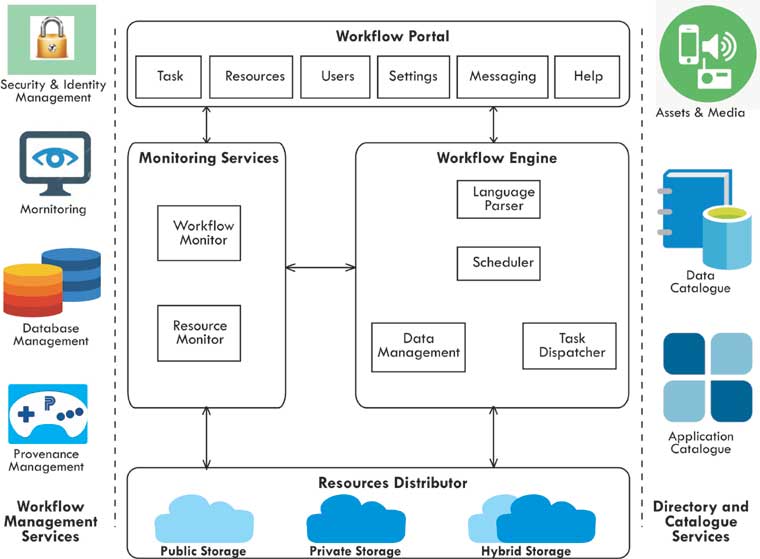
Architectural Diagram of how SLEEK WFMS
Database management component provides a reliable storage for intermediate and final data results of the workflows.
Provenance management services capture important information such as, dynamics of control flows and data, their progressions, execution information, file locations, input and output information, workflow structure, form, workflow evolution, and system information. Provenance is essential for interpreting data, determining its quality and ownership, providing reproducible results, optimizing efficiency, troubleshooting and also to provide fault-tolerance.